
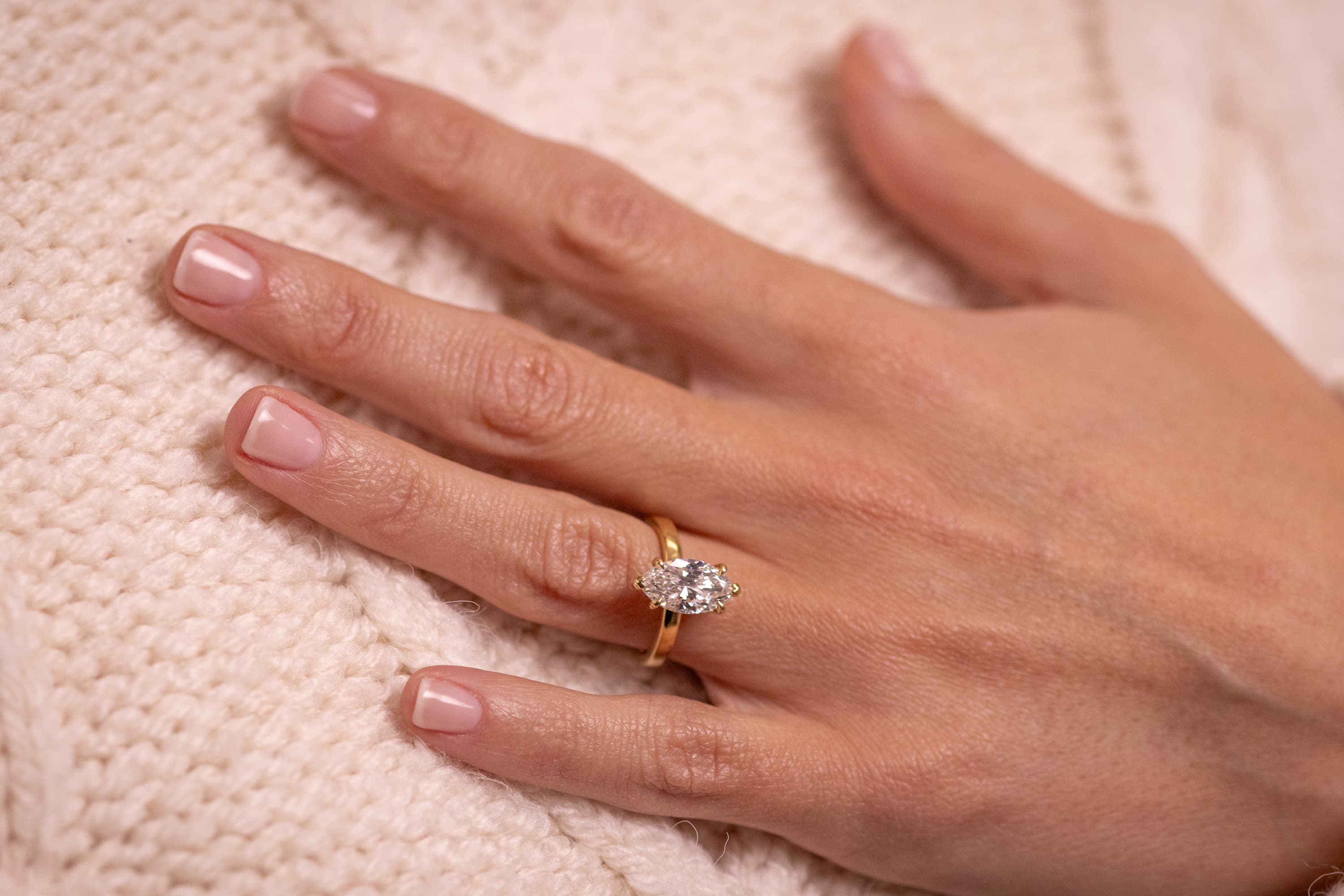
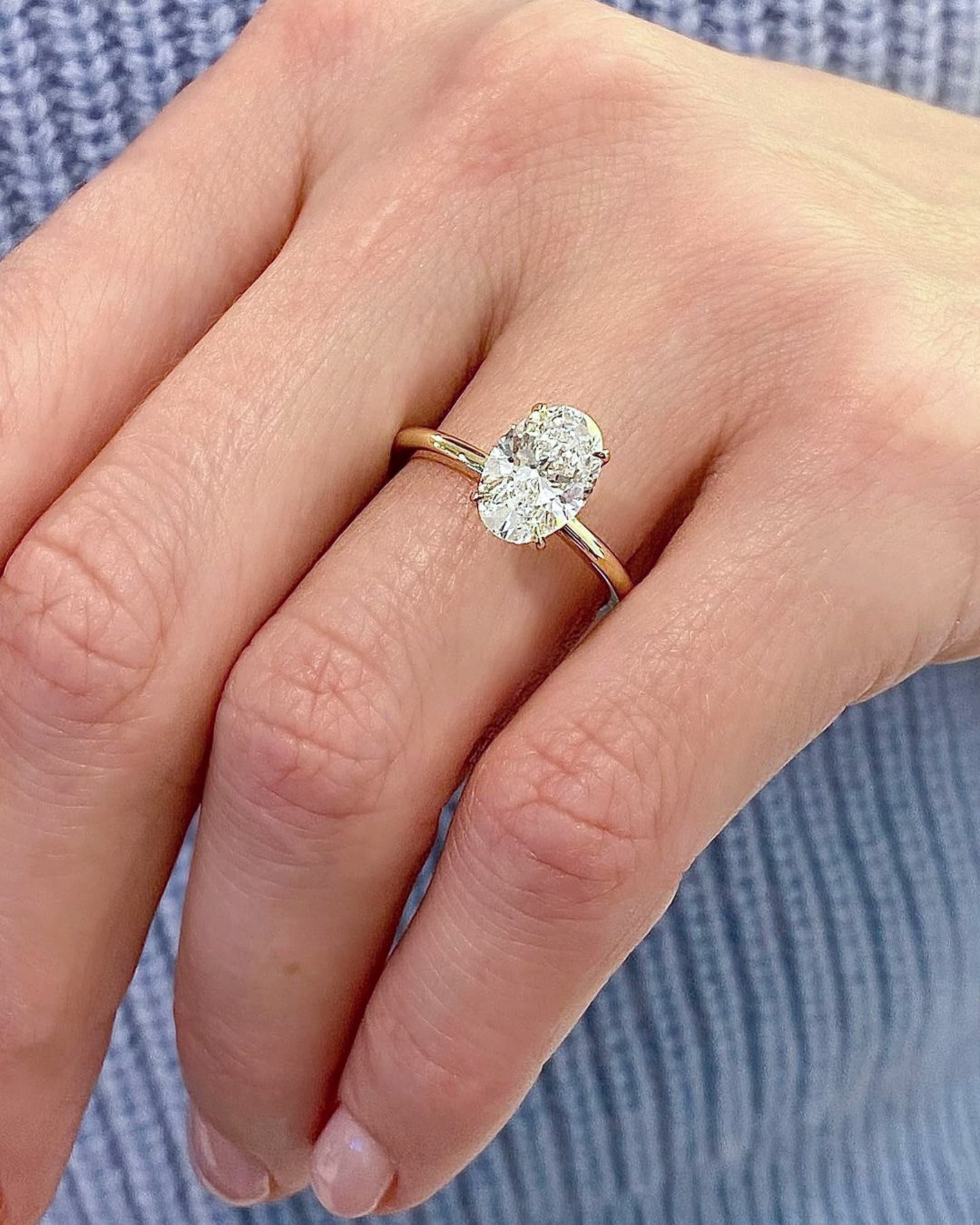
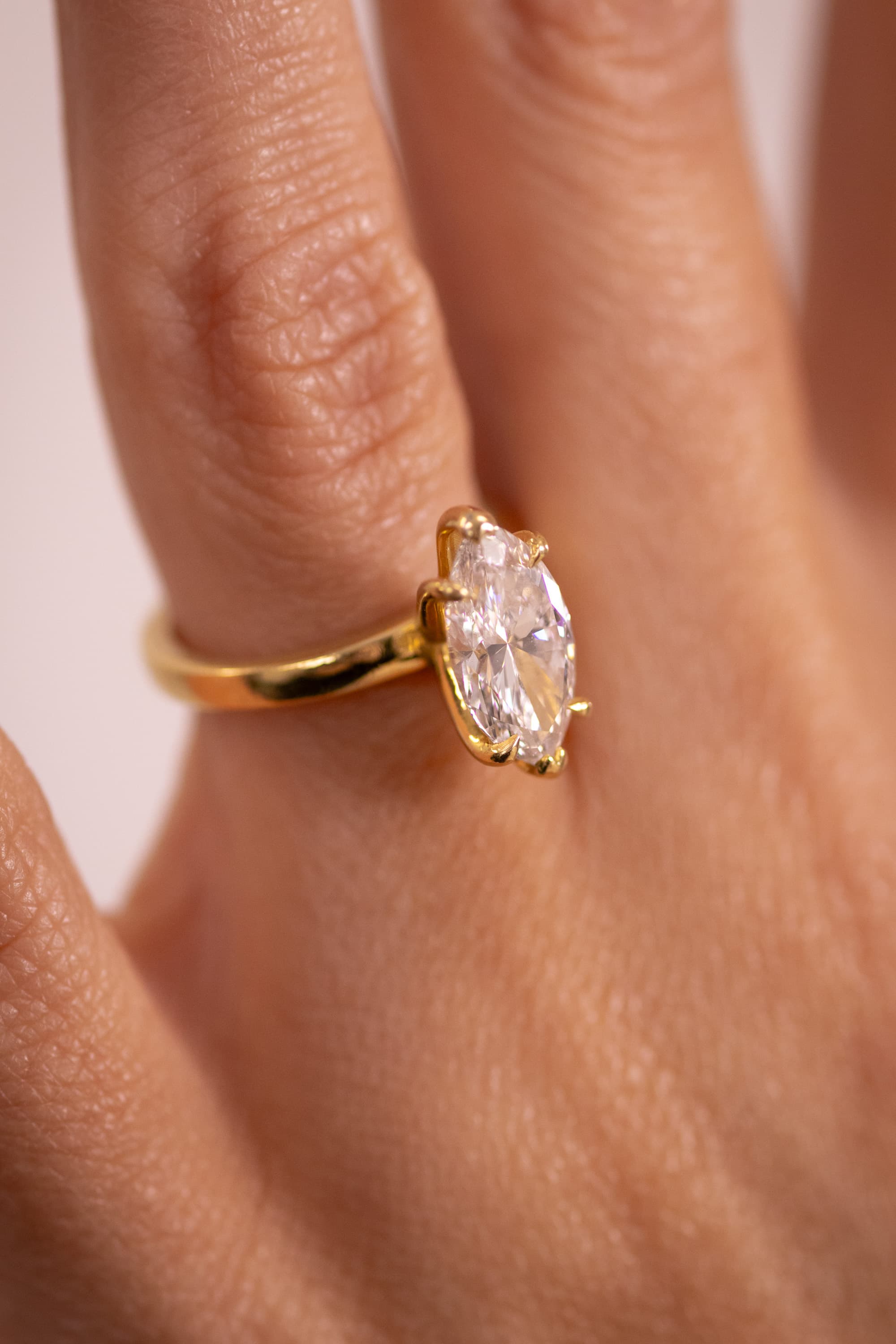
A moval diamond is an elongated, almond-shaped hybrid cut that blends the marquise and the oval: it keeps the marquise's dramatic length but softens the sharp points into rounded, tapered ends. At Savoir-Faire Jewellery, our Melbourne atelier treats it as one of the more interesting shapes to reach the mainstream in years — a modified-brilliant cut (roughly 57 to 58 facets, the same family as the oval, pear and marquise) that reads slimmer and more distinctive than a classic oval without the needle-sharp points of a true marquise.
One thing to know up front: moval is a trade nickname, not an official grading category. You will not find the word on a lab report — it appears there as something like "Oval Modified Brilliant." That small detail matters more than it sounds, and we come back to it below.
Why movals are having a moment
Search interest in the moval cut rose sharply through 2025 and 2026, and many bridal retailers have published guides on it. The driver is supply. Cutting an elongated hybrid from natural rough wastes a lot of carat weight, so almost no natural movals were ever cut for stock. Lab-grown diamonds remove that constraint — the rough can be grown and planned toward the intended cut — which is why the moval market today is overwhelmingly lab-grown. That fits how we work: we sell both, but we lean strongly toward lab-grown as the default, with natural available for those who want it.
Length-to-width ratio — a style choice, not a spec
Because a moval is not a standardised shape, there is no official "ideal" ratio. Trade consensus clusters between 1.5 and 1.8, with 1.6 to 1.75 cited most often as the sweet spot — more elongated than a classic oval (usually 1.35 to 1.5) but softer than a sharp marquise (often 1.85 to 2.1 and up). Treat the number as a look to choose by eye, not a pass-or-fail grade.
| Ratio | Look |
|---|---|
| 1.5–1.6 | Fuller, rounder face-up; reads close to an elongated oval |
| 1.6–1.75 | The most-cited sweet spot — balanced length with a soft taper |
| 1.8+ | Slim and dramatic, leaning toward a marquise silhouette |
Pick the ratio from face-up photos or video, not from a spec sheet — the same number can look different depending on how the cutter shaped the ends.
The bow-tie — normal, until it isn't
Every elongated modified-brilliant — oval, pear, marquise and moval alike — can show a bow-tie: a darker band across the centre where facets bounce light away instead of back to your eye. A faint, evenly shaded bow-tie is normal and not a defect. The warning sign is a dark, opaque bow-tie that stays fixed as you tilt the stone; that points to poor cut proportions, not to the shape itself. You can only judge this from face-up video — the certificate will not tell you.
What actually matters when you choose one
Two things carry more weight here than with a plain oval:
- Symmetry, checked by eye. Because a moval blends two shapes, a common hybrid flaw is an off-centre point or one long edge curving differently from the other. Look at face-up images for mirror symmetry across the long axis — do not rely on the certificate's symmetry grade alone to confirm it.
- Ratio, chosen by eye. As above, there is no correct number to chase. Decide whether you want the fuller or the slimmer look and shortlist to that.
If you are still deciding between shapes generally, our guide to choosing the perfect ring shape is a good companion read.
The certification trap every 2026 buyer should know
This is where movals catch people out, and it changed recently. Three facts to hold together:
- GIA gives no overall cut grade to any fancy shape — oval, pear, marquise or moval — as of 2026. Only polish and symmetry are reported. GIA has announced overall cut grades for select fancy shapes — oval, pear and marquise — from 2027, but they are not live yet, so there is no "Excellent cut" shortcut to lean on for this shape today.
- GIA stopped issuing full 4Cs on lab-grown diamonds from 1 October 2025. New GIA lab-grown reports now show only a "Premium" or "Standard" bucket — no per-stone colour or clarity numbers.
- Most lab-grown movals now carry IGI reports instead, because IGI still issues full 4Cs and already grades fancy-shape cut. The catch: many in the trade find IGI grades run about one grade more leniently than GIA on colour and clarity, so an IGI "VS1, E" can read closer to a GIA "VS2, F" in the hand. Treat an IGI grade and a GIA grade as not directly equivalent.
The practical takeaway: confirm which lab issued the report, read polish, symmetry and the proportions directly, and judge performance from video. Our explainer on diamond certificates and the 4Cs guide both go deeper here.
Why a moval looks bigger than its carat weight
Elongated shapes spread their weight across a longer face-up axis rather than hiding it in depth like a round brilliant, so a moval reads visually larger across the top — commonly around 10 per cent or more face-up area than a round of the same carat. It is a real, well-established geometric property of every elongated shape, not something unique to movals, and it is exactly why couples chasing more spread for their budget gravitate to cuts like this.
Settings that suit — and protect — a moval
The tapered tips of a moval are thinner than a round's girdle and, like a marquise's points, are the most chip-vulnerable part of the stone. Whatever the overall style, the setting must protect those tips:
- V-prongs or a bezel / half-bezel over the tips are the standard protective choice — not a plain four-prong.
- Cathedral and hidden-halo designs are the most commonly recommended styles — browse our hidden-halo collection to see the effect — and east-west orientation is trending for the shape in 2026.
- The basket should support the girdle along the full length, not just at the ends.
Our engagement ring styles guide shows how these read on the hand. Every ring we make is backed by a lifetime warranty and a complimentary resize within twelve months, so a protective setting is something we steer you toward rather than up-sell.
Sourcing, lead time and value
Because natural movals are rarely cut for stock, both natural and lab-grown movals are largely produced to order by a small number of specialist cutters. Set your expectations for a bespoke lead time rather than same-week shipping — this is not off-the-shelf oval inventory. Well-proportioned movals also carry roughly a 10 to 15 per cent premium over a comparable oval or marquise at the same carat, colour and clarity, reflecting the cutting precision and lower yield; that premium persists even in lab-grown.
On price more broadly, natural diamonds of equivalent specs typically cost several times more than lab-grown — often five times or more — and the gap widens at larger sizes. Premium lab-grown specs found a price floor in late 2025 — the years of steep annual declines are largely over — though week-to-week trackers stay noisy, so treat any single snapshot as indicative only. We re-verify live pricing for every stone: our Stone Concierge can source a moval to your exact spec, and our bespoke process walks through each step.
Common questions
Is a moval a real diamond shape?
Yes — it is a genuine modified-brilliant cut, an elongated hybrid of the marquise and oval. It simply is not a standardised, separately graded category, so it has no official "ideal" proportions the way a round brilliant does.
Will "moval" appear on the certificate?
No. It is a trade nickname. On a GIA or IGI report the shape is listed as something like "Oval Modified Brilliant," so do not expect to search a lab report for the word itself.
What length-to-width ratio is best for a moval?
There is no single correct number. Most sit between 1.5 and 1.8, with 1.6 to 1.75 the popular sweet spot. Lower looks fuller and rounder; higher looks slimmer and more dramatic. Choose by eye from video.
Are moval diamonds more expensive than ovals?
Usually a little — expect roughly 10 to 15 per cent more than a comparable oval at the same carat, colour and clarity, because the cut wastes more rough and demands more precision. Lab-grown keeps the overall cost far below natural.
Should I choose a natural or a lab-grown moval?
Most movals on the market are lab-grown, and that is our default recommendation — the same look and certification options at a fraction of the price. Natural is available if you specifically want it; both are an informed, valid choice.
How long will a moval take to arrive?
Plan for a bespoke lead time rather than immediate stock. Because most movals are cut to order by specialist cutters, sourcing and setting take longer than a standard round or oval — worth building into your timeline.
A moval rewards buyers who choose with their eyes: shortlist by ratio and symmetry on video, insist on tip protection in the setting, and check which lab graded the stone before comparing numbers. When you are ready, have our Stone Concierge source a moval to spec, book a consultation with our Melbourne atelier, or browse our engagement rings for inspiration.