
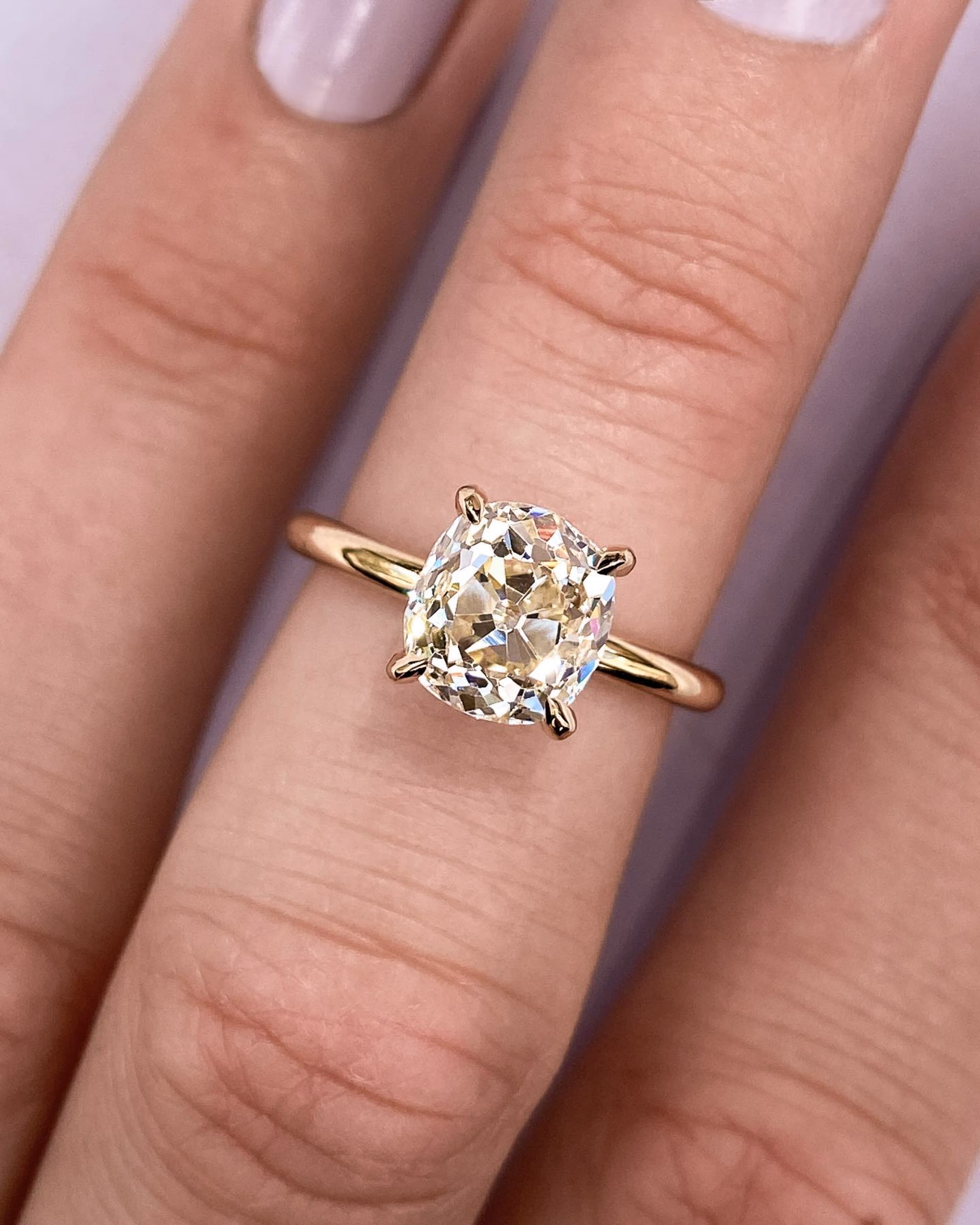
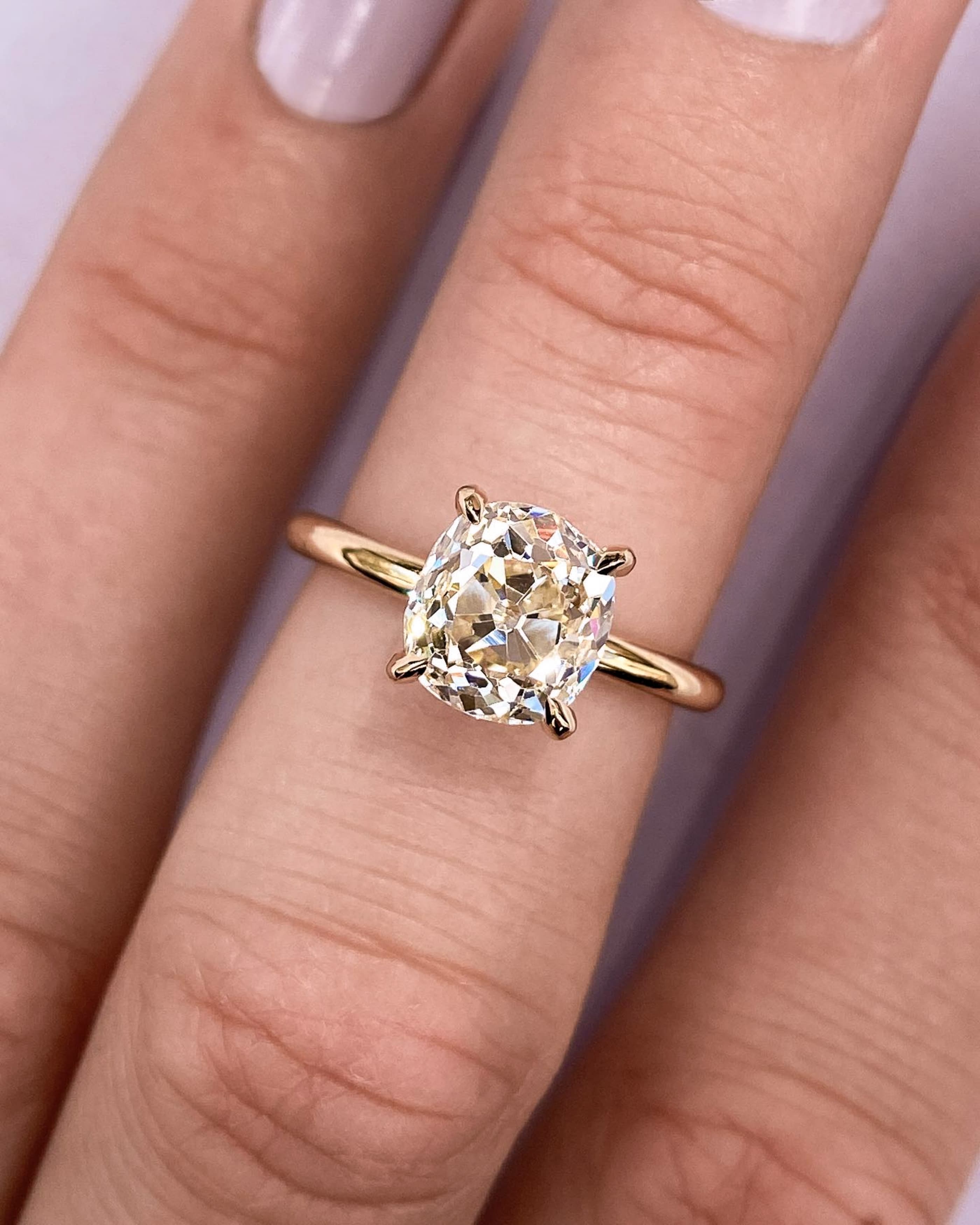
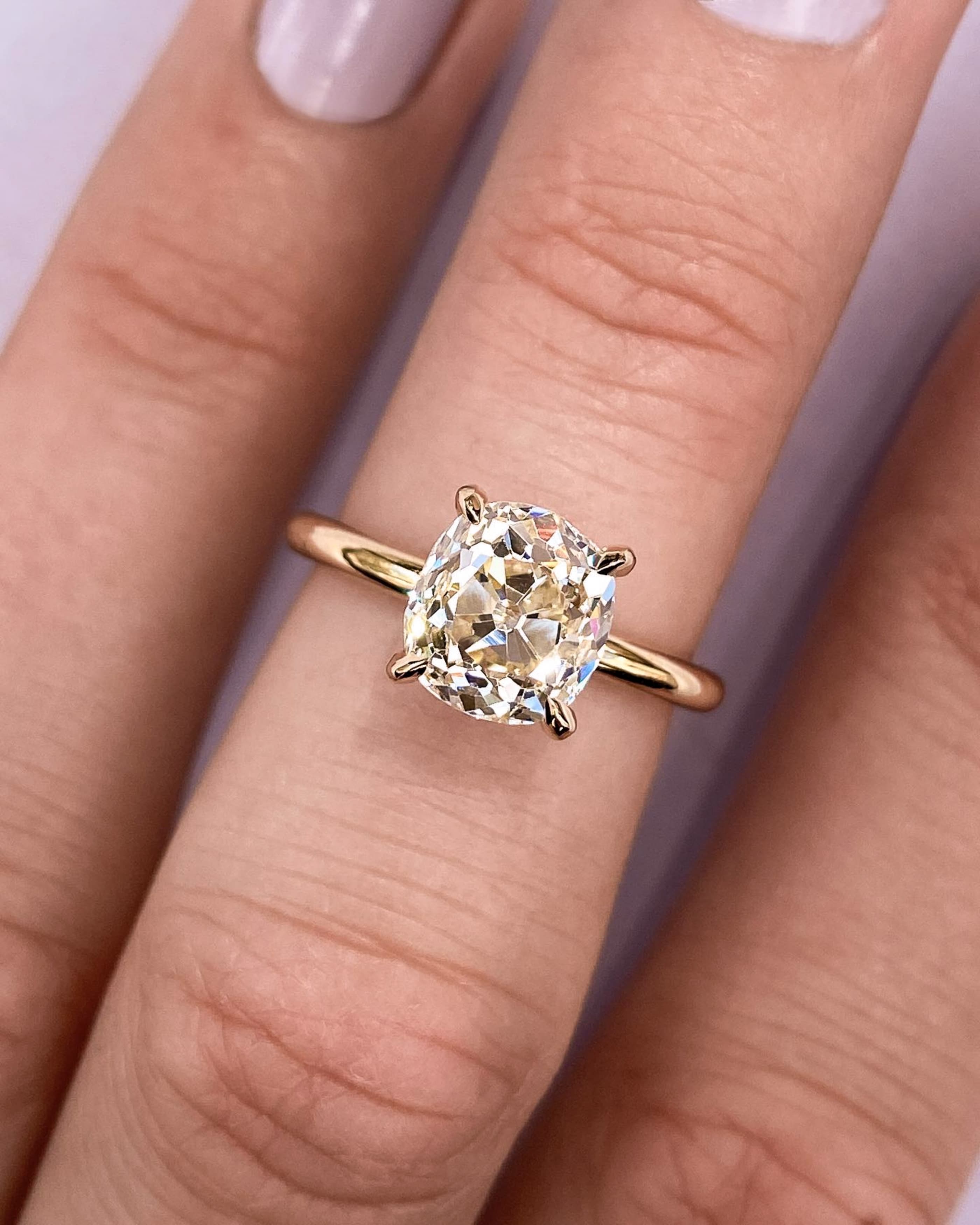
The old mine cut is an antique diamond style — hand-cut mostly through the 18th and 19th centuries — with a squarish, cushion-shaped outline, a small table, a tall crown, a deep pavilion and a large open culet (the small flat facet you can see at the very base of the stone, there by design, not a flaw). At Savoir-Faire Jewellery we work with these stones for couples who want the warm, candlelit character of a genuine antique, and with modern lab-grown old-mine-style cuts for those who love the look but want predictable size, quality and price. This guide covers what defines the cut, how it behaves in light, and the grading and sourcing traps worth knowing before you buy.
What actually defines an old mine cut
An old mine cut (OMC) has 58 facets — the same count as a modern round brilliant — but they are far fewer per zone and much larger, cut by eye and hand rather than by machine. The tell-tale features:
- Cushion outline: squarish with softly rounded corners, never a perfect circle.
- High crown, deep pavilion: the stone is tall top-to-bottom, with a lot of weight sitting below the girdle.
- Small table: the flat top facet is noticeably smaller than on a modern cut.
- Open culet: a small flat facet at the very tip, visible face-up as a tiny window — a period signature, not damage.
- Chunky, hand-cut facets: often slightly uneven, which is part of the charm.
| Feature | Old mine cut | Modern round brilliant |
|---|---|---|
| Outline | Cushion, rounded corners | Perfect circle |
| Facets | 58, large and hand-cut | 58, small and machine-precise |
| Culet | Open (visible) | Closed (pointed) |
| Light look | Fewer, bigger flashes; more fire | Bright, even scintillation |
| Face-up size | Wears smaller per carat | Wears larger per carat |
Where the name comes from
"Old mine" refers to the then-established mines of Brazil and Golconda in India, the world's main diamond sources before large African deposits were discovered from 1866 onward. The term caught on in the 1800s to distinguish the older, hand-cut stones from newer material. The cut sits at the start of a clear lineage: the old mine cut gave way to the rounder, more symmetrical old European cut as steam-powered bruting improved late in the century, which in turn led to Marcel Tolkowsky's mathematically "ideal" round brilliant in 1919. If you are weighing up less conventional diamond silhouettes, the moval cut is another distinctive modern shape worth a look.
Candlelight, not showroom light
Because the facets are large and few, an old mine cut throws slower, bigger flashes of light and dark, with pronounced fire — the spectral colour broken out of white light. It has less of the rapid, even sparkle (brilliance and scintillation) that a well-cut modern round delivers. These stones were literally cut to glow under candlelight and gaslight, so they can look sleepier under a jewellery-store LED spotlight than a modern round sitting beside them. That is the cut doing exactly what it was designed to do, not a quality problem.
Size gotcha: because so much weight hides in the deep pavilion, an OMC wears smaller face-up than its carat weight suggests. A 1 carat old mine cut looks noticeably smaller from the top than a 1 carat modern round. Judge visible size by millimetre spread, not carat weight, when you compare the two.
The grading traps every buyer should know
This is where antique cuts trip people up. Two things matter.
1. There is no cut grade — and that is normal. GIA and IGI will grade an old mine cut's colour, clarity and carat weight and record its exact proportions, but they do not assign a cut grade (Excellent to Poor). That scale is calibrated only to modern round brilliants; an OMC would simply score "Fair" or "Poor" against maths it was never cut to, so the labs leave it blank rather than penalise the style. A missing cut grade is expected, not a red flag. We keep the full explainer on our 4Cs guide.
2. A report grades the stone, not its age. A GIA or IGI report describes the stone as it exists today. It will note the shape — usually recorded as a cushion variant such as "Cushion Modified Brilliant," with the cutting style flagged as Old Mine where the lab offers that field — but it does not certify that the diamond is a genuine 18th or 19th-century antique. "Old mine cut" on a report describes facet arrangement, not provenance. To confirm a true period origin you need a separate specialist appraisal, dealer provenance, or era-consistent tells: an original period setting, hand-cut asymmetry, an uneven or thick girdle, extra "chip" facets. Our certificates guide explains what a report does and does not prove.
Genuine antique or lab-grown old-mine-style?
Plenty of new-cut stones — both natural and lab-grown — are cut today to mimic the old mine look, and they can be near-identical to the eye. Neither is a fake; the only mistake is buying one thinking it is the other. Reputable sellers describe a new stone as "antique-style" or "old-mine-style," never as a period antique. Here is how the two paths compare:
| Consideration | Genuine antique | Lab-grown old-mine-style |
|---|---|---|
| Supply | Fixed and finite; estate and auction only | Made to order, widely stocked |
| Sizes | Whatever exists; large stones rare | Large carats readily available |
| Quality | Variable, as-found | Commonly D to H colour, VS clarity |
| Price | Higher and unpredictable | Lower and predictable |
| Character | True period tells and history | The look, without provenance |
Genuine antique supply is non-renewable — these stones are not cut to order, so a specific size and quality combination may simply not exist on the market when you want it. If you love the romance and the history, that hunt is part of the appeal, and our Stone Concierge can source a stone through estate and dealer channels to your brief. If you want the candlelit look with a guaranteed size, budget and grade, a lab-grown old-mine-style stone is the practical choice, and the one we most often recommend.
Interest in the cut has surged lately: Taylor Swift's 2025 engagement ring from Travis Kelce is widely reported as an old mine brilliant of roughly 8 carats, with some outlets estimating considerably larger, which has sent more couples looking for the style. Reported valuations vary so wildly across outlets that no single figure is reliable — admire the cut and ignore the price tags in the headlines.
Do not recut a good antique
It can be tempting to "improve" an antique stone's symmetry or chase a cut grade it will never officially receive. Resist it. Recutting an old mine cut typically destroys 20 to 30 per cent of its carat weight and permanently erases the era-specific facet character that is the entire source of a collector stone's value and appeal. Specialists advise against recutting intact, collector-quality antiques. Recutting only makes sense for stones that are genuinely damaged or in poor condition with no collector value.
Settings that suit an old mine cut
The deep pavilion and tall crown shape the setting choice:
- Bezel: a full metal surround is historically correct for Georgian and Victorian pieces, and it protects an antique stone's often thin or chipped girdle — the practical pick for everyday wear. Browse our bezel collection to see the look.
- Claw or prong (2, 4 or 6): lifts the high crown and exposes more of the facet pattern to light, best when showing off sparkle matters more than guarding a fragile girdle.
- Low-profile bezel or basket: suits the cut naturally, since the deep pavilion already sits the stone lower on the hand.
- Period detailing: milgrain edges, filigree galleries and cathedral shanks are the design pairings that read as authentically antique.
Most of these look their best in warm metals; our gold versus platinum guide covers how each wears and ages if you are choosing a band to match.
Who the old mine cut is for
Choose it if you love visible history, warm candlelit character over showroom flash, and a one-of-a-kind stone with soul. It also appeals to anyone resetting a family diamond in the period style — see our piece on reimagining heirloom rings. It is a weaker fit if your priority is maximum face-up size per dollar or the brightest possible sparkle under any light; a modern brilliant will serve that better.
Common questions
Is an old mine cut a type of diamond or a shape?
It is a cutting style, not a separate gem. An old mine cut is a diamond finished in an antique faceting pattern with a cushion outline, high crown, deep pavilion and open culet.
Why is there no cut grade on my old mine cut report?
Because cut-grade scales only apply to modern round brilliants. GIA and IGI grade the colour, clarity and carat and record the proportions, but leave cut grade blank for antique styles. It is normal and not a sign the stone is lesser.
Does a GIA or IGI report prove my diamond is a genuine antique?
No. The report grades the stone as it is today and describes the cutting style; it does not certify age or era. Genuine antique status needs separate provenance or a specialist appraisal.
Is a lab-grown old-mine-style diamond a fake?
No. It is a real diamond cut to look like the antique style. It simply is not a period antique, which is why honest sellers call it "old-mine-style" rather than antique.
Why does my 1 carat old mine cut look smaller than a 1 carat round?
Because the deep pavilion holds more weight below the girdle, so less of the carat shows face-up. Compare by millimetre spread, not carat weight, to judge visible size.
Should I recut an old mine cut to make it sparkle more?
Almost never. Recutting typically loses 20 to 30 per cent of the weight and erases the antique character that gives the stone its value. Only consider it for badly damaged stones with no collector value.
An old mine cut rewards buyers who value character over spec sheets. To see options in person, book a consultation with our Melbourne atelier, have our team source a stone to your exact brief, or browse our engagement rings to find a setting that suits the style.