
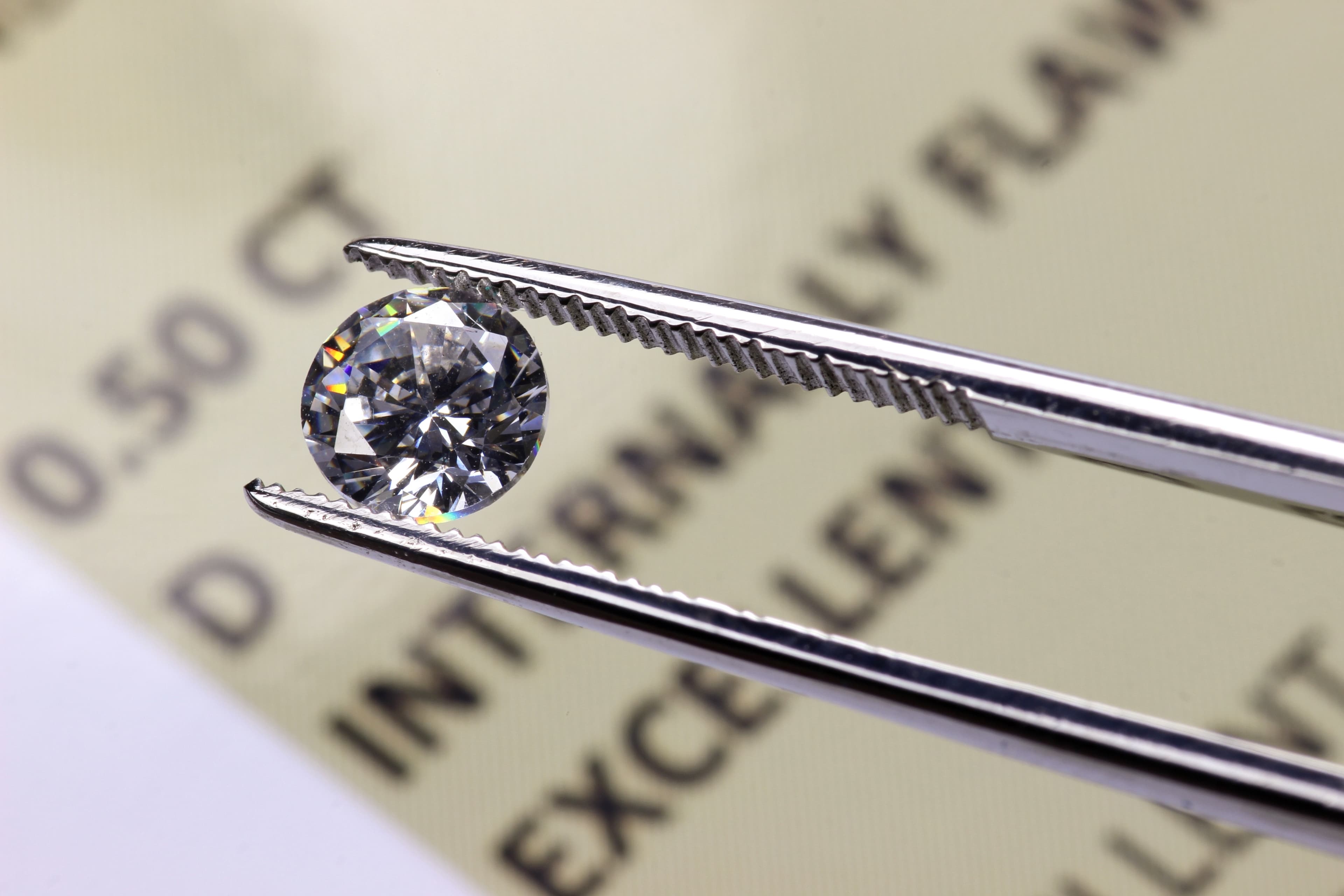
A diamond certificate — properly a grading report — is an independent laboratory's scientific description of one specific stone: its 4Cs, proportions, fluorescence and laser inscription. It carries no dollar value. At Savoir-Faire Jewellery every diamond we sell is independently certified — primarily by IGI, and also GIA and GCAL — because that report is your strongest protection against paying for a stone that isn't what the seller claims. The catch most Australian buyers miss is threefold: a grading report is not a valuation, the labs do not all grade to the same standard, and the rules for lab-grown reports changed in October 2025. Here is what actually matters, and where people get caught out.
Report vs valuation: two documents, two jobs
This is the confusion that costs people money, so settle it first. A grading report describes the stone — cut, colour, clarity, carat, measurements — and nothing else. It never states a price. A valuation (or appraisal) is a monetary estimate, almost always a "retail replacement value for insurance purposes", written by a qualified jewellery valuer who references the grading report and then adds current market pricing, the metalwork, the setting and the labour. Different document, different author, different purpose.
Your insurer wants the valuation. A grading report alone will not get a claim paid, and a valuation alone tells you nothing verifiable about the stone. When you insure a ring, ask for both. In Australia, get the insurance valuation from an NCJV Registered Valuer (the National Council of Jewellery Valuers keeps a public "Find a Valuer" directory) or a JAA-recognised valuer, ideally one independent of whoever sold you the ring. Refresh it every two to three years as prices move — this matters more for lab-grown diamonds, whose per-carat prices have kept falling year on year — one reason couples are choosing bigger lab-grown centre stones — so a five-year-old valuation can badly misstate replacement cost.
The labs worth trusting — and the one to avoid
Three laboratories cover almost everything you will sensibly consider, and their differences are real. Grades are only as meaningful as the lab behind them, so this is not a formality.
| Lab | Best for | Worth knowing |
|---|---|---|
| GIA | Natural-diamond 4Cs — the strictest, most consistent benchmark | Since Oct 2025 grades lab-grown as Premium/Standard only, not D-Z |
| IGI | Lab-grown — full 4Cs, highest volume, the practical default | Runs about one grade more lenient than GIA on average — not fake, just not 1:1 |
| GCAL | Cut and light-performance analysis (its "8X" grade) | Stricter than GIA Excellent; awarded to only about 1% of GIA-Excellent stones |
The gap between IGI and GIA is the one to internalise. IGI is a legitimate, globally dominant lab; it simply tends to grade colour and clarity a touch more generously than GIA in aggregate. That is not a reason to distrust an IGI report — it is a reason never to treat a GIA G/VS1 and an IGI G/VS1 as interchangeable when you compare prices. If you are weighing two stones, check they were graded by the same lab, or adjust your expectations accordingly. The mechanics of each grade are covered in our 4Cs guide.
The lab to treat with suspicion is EGL. It has a documented history of grading three to four grades more lenient than a GIA equivalent, a business model where dealers can decline unfavourable pre-grades before paying, and a reputation so poor the RapNet trading network banned EGL-only listings after overgrading scandals. An EGL "F/VVS1" can be a GIA I/SI in reality — a different category of problem from the modest, honest variance between IGI and GIA.
The GIA lab-grown change every buyer should know (October 2025)
This is the newest and most misunderstood shift, so read it carefully. From 1 October 2025, GIA stopped issuing specific 4C grades for laboratory-grown diamonds of 0.15ct and above. There is no more D-Z colour or FL-I3 clarity for lab-grown at GIA. In their place is a two-tier Laboratory-Grown Diamond Quality Assessment: your stone is either Premium or Standard, or — if it falls below the Standard minimums — it receives no assessment at all (just a small processing fee). GIA's reasoning is that lab-grown quality clusters in a narrow band, so descriptive tiers are "appropriate", and that lab-grown deserves treating as a distinct manufactured product.
| GIA tier | Roughly equates to |
|---|---|
| Premium | D colour, VVS clarity or better, excellent polish/symmetry and cut (rounds) |
| Standard | E-J colour, VS clarity, very good polish/symmetry and cut (rounds) |
Two gotchas here. First, and most important: this affects lab-grown only. GIA's natural-diamond D-Z 4Cs grading is completely unchanged — GIA has not "stopped grading diamonds", and a natural GIA report is as detailed and strict as ever. Second, the tiers are all-or-nothing: there is no longer any way to obtain a specific colour or clarity grade for a lab-grown stone from GIA, and very small melee under 0.15ct is not covered by the service at all.
IGI, by contrast, still issues the full, specific 4Cs for lab-grown diamonds — the same D-Z colour and FL-I3 clarity scales as for natural, plus proportions, clarity plot, fluorescence and growth-method disclosure. That makes IGI reports far more useful for like-for-like quality and price comparison in 2026. IGI already graded most of the world's lab-grown output before this, and the GIA change only cements that position. So if a lab-grown listing carries an IGI report rather than a GIA one, that is now completely normal — not a sign of a lesser lab or a shady seller. Our ultimate Australian lab-grown guide goes deeper on how this reshapes shopping.
How to read a report in five moves
Whether it is a natural GIA report, an IGI lab-grown report or a pre-October-2025 GIA lab-grown one, the same five checks tell you what you need.
- Verify the laser inscription. This is the single most actionable, lowest-effort authenticity check you can do — and it is free. Under a loupe or microscope, the number laser-inscribed on the diamond's girdle should exactly match the report number. Any reputable jeweller will let you do this in-store; reluctance to allow it is a red flag in itself.
- Read the 4Cs block — and know its limit. Colour, clarity and, for round brilliants, an overall cut grade. Fancy shapes (oval, emerald, pear, cushion) get proportions and finish data but no overall cut grade, so you cannot lean on the certificate for cut on anything but a round.
- Use the clarity plot as a fingerprint. The diagram mapping inclusions is not just a clarity indicator — it is a unique map that lets you confirm the physical stone in front of you is the one on the paper.
- Check the proportions diagram. Table %, depth %, crown and pavilion angles, girdle and culet. These numbers drive light performance more than the headline grade — a stone can be "Excellent" on paper and still leak light if the proportions are pushed.
- Read fluorescence and comments correctly. Fluorescence (none to very strong under UV) is a neutral trade characteristic, not a flaw — strong blue only rarely causes faint haziness, and often does nothing visible at all. The comments section is where treatments and, for lab-grown, the growth method appear.
Lab-grown certificates and the disclosure question
Both IGI and legacy pre-October-2025 GIA reports disclose the growth method — HPHT or CVD — in the comments and inscribe the girdle accordingly. This disclosure is routine and expected; it makes no difference to how the diamond looks or wears. What you should confirm is that the inscription plainly reads "Laboratory-Grown" (or equivalent) rather than being buried in fine print.
Disclosure is also becoming a live regulatory issue. In May 2026 the UK's Advertising Standards Authority upheld complaints against Novita Diamonds — an Australian retailer — and Linjer for advertising lab-grown stones as plain "diamonds" without a clear qualifier. Australia has no direct ACCC ruling on this yet, but the Australian Consumer Law already covers the same ground through its prohibitions on misleading conduct and false representations (ss18 and 29), so the same disclosure standard should be assumed here. The takeaway for buyers: a stone described only as a "diamond" with no prominent lab-grown qualifier is a reason to ask questions, not a bargain.
The Australian buyer's checklist
- Treat "certificate" and "valuation" as two separate documents from two separate roles, and ask for both when insuring.
- Get the insurance valuation from an NCJV Registered Valuer, independent of the seller where possible, and refresh it every two to three years.
- Remember GST applies to jewellery bought in Australia, and loose stones imported personally can attract GST and duty at the border.
- Expect IGI to dominate lab-grown listings since October 2025 — that is normal now, not a warning sign.
- Never cross-compare grades between labs as if equal; a GIA G/VS1 is not an IGI G/VS1.
Myths worth killing
"The certificate proves the price." False. It describes quality only; a report has no dollar figure on it.
"All labs grade the same." False. The consistency gaps above are real and affect value.
"An insurance appraisal is the same as a grading report." False. Different purpose, different issuer, not interchangeable.
"No certificate but a great price means the same quality for less." A missing independent report on a stone above melee size is a reason for scrutiny, not a discount.
Red flags
- In-house "certificates" where the seller grades its own stock — the classic conflict of interest.
- Appraisal-only paperwork with no independent grading report behind it, especially if written by the seller.
- Grade inflation on an unfamiliar regional lab, or a "soft" report with no plot, proportions or inscription detail.
- A seller reluctant to let you verify the laser inscription independently.
- Any lab-grown stone described as a plain "diamond" with no clear, prominent qualifier — now an active enforcement risk, not just poor etiquette.
Common questions
Is a diamond certificate the same as a valuation?
No. A grading report describes the stone's characteristics and carries no price; a valuation is a monetary estimate for insurance, written by a valuer who references the report. Insurers want the valuation, so ask for both when you insure.
Which diamond lab is most trusted in Australia?
GIA is the strictest, most consistent benchmark for natural diamonds. IGI is the practical default for lab-grown because it still issues full 4Cs reports and grades most of the world's output. GCAL is respected for rigorous cut analysis. All three are trustworthy; EGL is the one to avoid.
Did GIA stop grading diamonds in 2025?
No — that is a common misreading. GIA still grades natural diamonds on the full D-Z, FL-I3 scale exactly as before. It only changed lab-grown reports from October 2025, replacing specific 4C grades with a two-tier Premium/Standard assessment for stones 0.15ct and up.
Why do most lab-grown diamonds now have IGI reports, not GIA?
Because GIA no longer issues specific 4C grades for lab-grown, while IGI still does. Buyers and sellers want the detailed, comparable letters, so IGI grades the clear majority of lab-grown stones. An IGI report on a lab-grown diamond is completely normal in 2026.
How do I check a diamond certificate is genuine?
Verify the laser inscription: under a loupe, the number on the girdle should match the report number, and you can confirm the report itself on the lab's website. It is a free, one-minute check, and any reputable jeweller will let you do it in-store.
Is diamond fluorescence a bad thing?
Usually not. Fluorescence is a neutral trade characteristic; strong blue fluorescence only occasionally causes faint haziness and often has no visible effect at all. It is worth understanding on a report, but it is not a defect by itself.
Read the report, verify the inscription, and keep the valuation separate — do that and you cannot be sold a stone that isn't what it claims. When you are ready, you can have us source a certified stone to your exact spec, browse our engagement ring collection or our show-stoppers collection for pieces where a well-documented centre stone is the whole point, or book a consultation and we will walk through real reports and videos with you, side by side.