
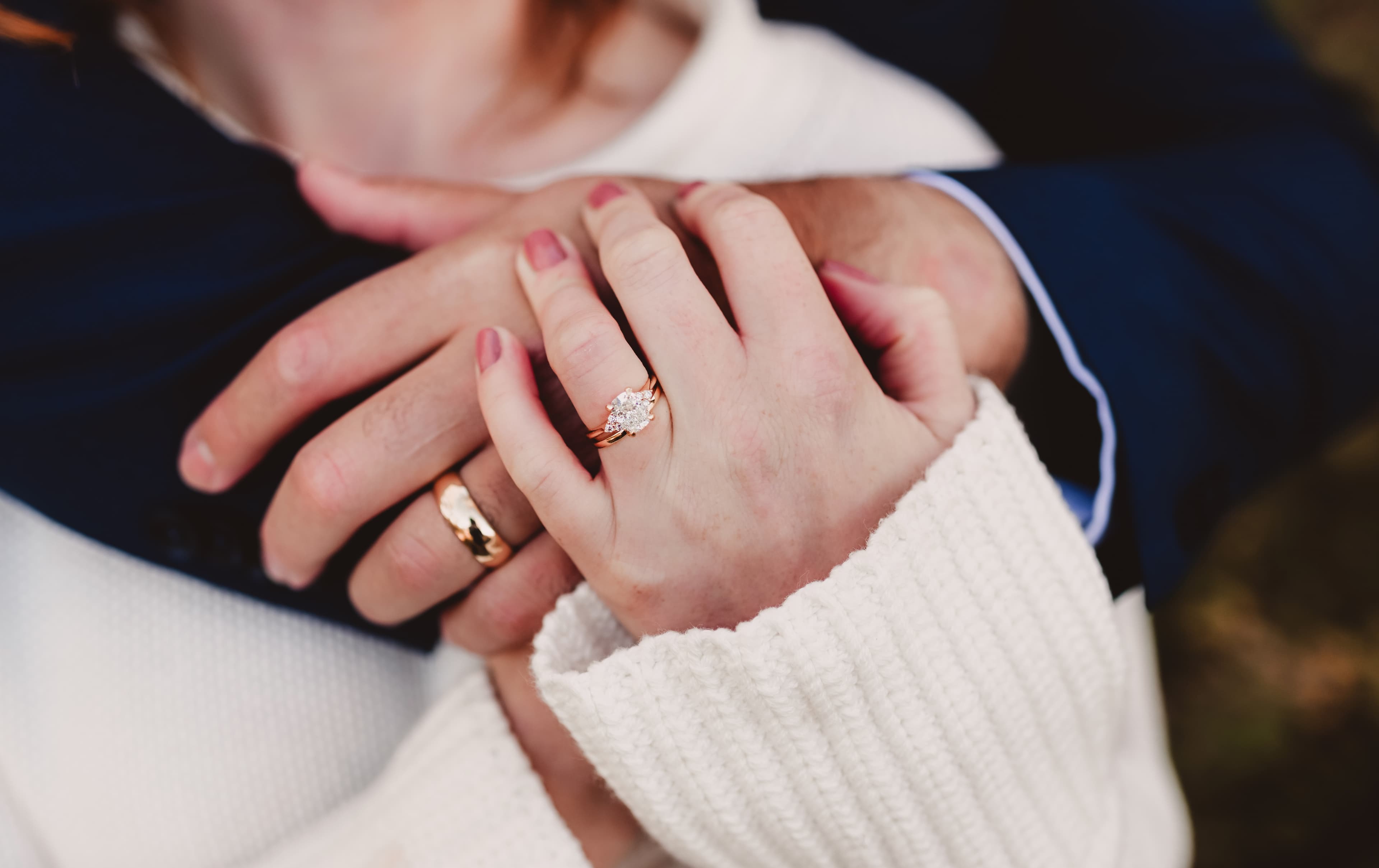
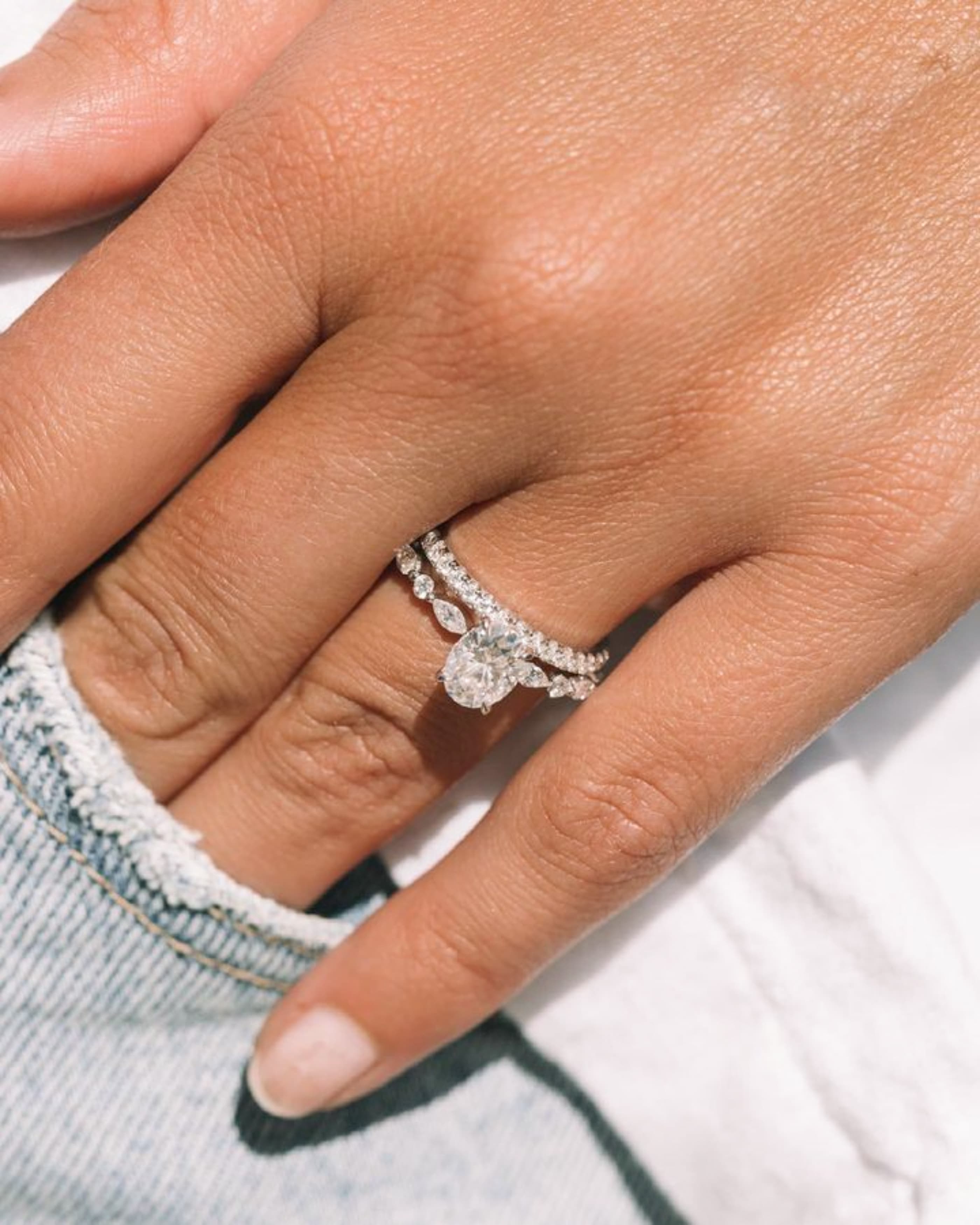
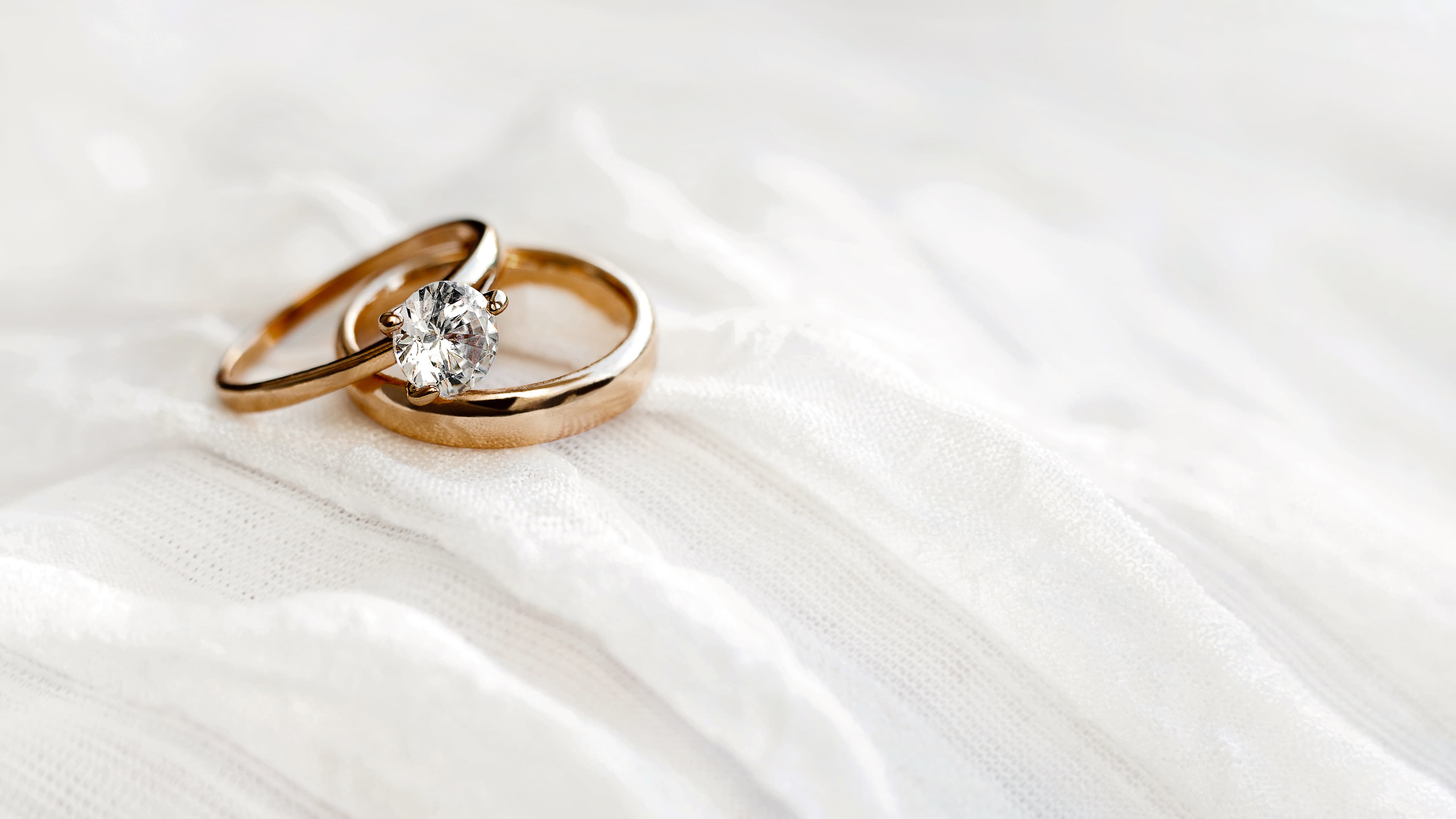
A wedding ring — or wedding band — is the ring you exchange at the ceremony and then wear every day for the rest of your life, usually sitting flush against your engagement ring on the same finger. At Savoir-Faire Jewellery we make both halves of that pairing in our Melbourne workshop, so this guide is the advice we give across the bench: how to make the band sit right against your engagement ring, which metal to choose (and the wear trap most people miss), and the two or three decisions that are genuinely hard to undo. If you read one line: match the band's metal to your engagement ring, choose a half-eternity over a full eternity if your finger size might ever change, and have both rings in hand about a month before the wedding.
Everything below is ordered by what actually goes wrong, not by what looks prettiest in a catalogue. Most wedding-band regret comes from three things — a band that won't sit flush, a metal that wears badly against its neighbour, and a ring that can't be resized when a finger changes. Get those right and the style is the easy part.
Match, complement or contour: how the band sits with your ring
The first job of a wedding band is to sit cleanly against your engagement ring, and whether it will depends entirely on your engagement ring's setting. A plain solitaire or a low bezel sits flat, so a straight band nestles right up against it with no gap. A raised setting — a high-set solitaire, a halo, prominent claws or side stones — is where a straight band fails: it leaves a visible wedge-shaped gap, and worse, it rocks against the finger because only one edge makes contact.
That is what a contoured, curved or "shadow" band solves. It is shaped with a notch or gentle curve that hugs the engagement ring's profile so the two sit flush. This is a fit issue, not a style choice — and the gotcha runs both ways. If your setting is raised, don't assume a pretty straight band will work; it usually won't. If your setting is flat or bezel-set, don't let anyone upsell you a curved band you don't need. A shaped band nearly always has to be custom-cut to your specific engagement ring, which is why we ask you to bring the ring in — and why it adds time you have to plan for.
Metal matching and the hardness trap
Most couples match the band's metal to the engagement ring, and there's a practical reason beyond looks. When two rings of different hardness rub together, the softer one wears away faster at the contact point — year after year, on the same hand or between clasped hands. Put a gold band next to a platinum engagement ring and the gold loses that contest over a decade. So the trade-standard advice is to match the metal — or at least the hardness — between the two rings you will wear together. This matters more than most buyers assume.
The counter-intuitive part: in everyday jewellery alloys platinum is actually softer than 14k or 18k gold, yet it wears better. Because platinum is dense and worn nearly pure, a scratch displaces the metal rather than shedding it, so a platinum band develops a soft patina and barely thins over decades. Gold sheds a little material every time it scratches, so a gold band gradually thins. For everyday durability the order runs platinum and palladium first, then 18k and 14k gold. See our gold vs platinum guide for the full comparison.
| Metal | How it wears | Ongoing upkeep |
|---|---|---|
| Platinum | Dense; scratches displace metal, so it patinas rather than thinning | Repolish when you like; no plating |
| 18k yellow / rose gold | Harder surface, but sheds tiny amounts when scratched, so thins slowly over decades | Occasional polish |
| 18k white gold | Wears like gold, plus a rhodium coat that rubs off | Re-plate every 6-24 months (~AUD $60-$225) |
The white-gold gotcha deserves its own line. White gold is rhodium-plated for its bright, cool colour, and that plating wears off — typically every 6-24 months depending on wear, sooner on a daily-worn ring and longer if you are gentle on your hands. Re-plating in Australia runs roughly AUD $60-$225 a visit, most often $100-$200. Treat white gold as a ring with a small recurring maintenance cost, not a one-off purchase. Platinum costs more upfront but has no plating to redo — it is genuinely white all the way through. Factor that into the comparison, and keep it in mind alongside the rest of your jewellery care.
Width, profile and comfort-fit — why your usual size may not carry over
Width is mostly taste: narrow bands (2-4mm) pair neatly against a delicate engagement ring and suit stacking; wider bands (7mm+) show more metal, read bolder, and are the common choice for men's rings. But width has a sizing consequence — a wider band feels tighter at the same marked size because more metal grips the knuckle, so wide bands usually need sizing up slightly.
Profile is the shape of the band's inner edge, and it changes fit more than people expect. A comfort-fit band has a rounded, domed interior that touches less of your finger, so it slides over the knuckle easily and a given size feels looser than a flat-profile band. Buyers moving from flat to comfort-fit (or the reverse) often need to re-check their size — many size down about half a size for comfort-fit. The rule: never assume your usual ring size carries across a change in width or profile. Get measured for the actual band you are buying.
Plain, pavé or eternity — and the one mistake you can't undo
Bands run from plain polished metal, through pavé (a row of tiny diamonds set into the top), to eternity (stones set around the band). Plain bands are the most durable and the easiest to resize and engrave; pavé and eternity add sparkle that matches a diamond-set engagement ring. Because lab-grown diamonds have made small stones far cheaper than they were pre-2020, a fully diamond-set band — set with lab-grown or natural stones — is now much more affordable, but affordability doesn't change the single biggest trap in this category.
A full eternity ring — stones set 360° around the band — usually cannot be resized at all. There is no bare metal to cut and rejoin, and any attempt risks loosening or losing stones. If your finger size ever changes — weight change, pregnancy, knuckle swelling in warm weather or with age — you are left with a replacement, not an adjustment. This is the highest-stakes decision in wedding-band buying.
The fix is simple: if you have any doubt about long-term size stability, choose a half- or three-quarter eternity instead. These set stones across the top of the band only and leave plain metal at the back, which can typically be resized about one size up or down — and they look identical from above, where it counts. Reserve full eternity for buyers confident their size is settled.
| Style | Best for | The catch |
|---|---|---|
| Plain / polished | Durability, men's bands, easy resizing and engraving | Shows fine scratches (easily polished out) |
| Pavé | Matching sparkle to a diamond-set engagement ring | Small stones need checking; trickier to resize |
| Half / three-quarter eternity | Sparkle across the top, plain metal at the back | Resizes about one size — the safe choice if size may change |
| Full eternity | Maximum sparkle, stones 360° around | Cannot be resized — size must be right for life |
Men's bands: the resizing rules are different
Precious-metal men's bands in gold or platinum resize like any other ring. But the popular contemporary materials do not: tungsten carbide, ceramic, titanium and cobalt-chrome bands cannot be resized under any circumstances. The tools and heat a jeweller would use either can't cut the material or would fracture it, so if the fit changes the only option is a new ring — not an adjustment. This is distinct from precious-metal bands, and it catches people out. If you are drawn to one of these harder modern materials for its scratch resistance and price, the size must be exact at the time you order. Get measured properly, and if your fingers change size seasonally, size for your larger reading. For a ring you may want to adjust later, stay with gold or platinum.
Ring sizing in Australia
Australia shares a letter-based sizing system with the UK, New Zealand, Ireland and South Africa — running roughly from A (smallest) to Z and beyond, with half sizes written like "N½". This is structurally different from the US numeric system and the European circumference system you will see on overseas sites, so use the AU letter as your reference and treat US and EU as conversions. Most Australian women's bands fall between I and U, with the single most common size around N (about US 6¾).
| AU / UK size | US (approx) | Inside circumference |
|---|---|---|
| J | 4¾ | ~49 mm |
| L | 5¾ | ~51.5 mm |
| N (most common) | 6¾ | ~54 mm |
| P | 7¾ | ~56.5 mm |
| R | 8¾ | ~59 mm |
The most reliable method is a free in-store finger sizing on a proper metal ring gauge — far better than a printable paper strip or a ring-to-millimetre chart, which are easily thrown off by paper thickness or a ring measured at the wrong point. We include a complimentary ring sizer with online orders, and you can request one through our ring size finder. Measure at the end of the day when fingers are at their largest, and in normal temperature — cold shrinks fingers noticeably.
Timing: order and size before the wedding, not during it
The most avoidable stress is leaving bands to the final weeks. Trade consensus — and ours — is to start shopping 3-4 months out and have both rings in hand around a month before the wedding. An in-stock band can be ready in a week or two, but anything custom takes longer: engraving, resizing, and especially a contoured band that must be cut to fit your engagement ring can each add a week to a month. A shaped band is custom work by definition, so it sits at the slower end. Build in that buffer and leave room for a final fitting.
One cost note worth understanding: gold-band prices are elevated right now because the gold price sits near record highs, and spot gold moves daily — so treat any per-gram or "from" price as indicative rather than fixed. A wider or heavier band uses more metal and costs more accordingly.
Common questions about wedding rings
Do my wedding band and engagement ring have to be the same metal?
No, but matching is the safer choice. Different metals wear at different rates, and a harder ring will slowly wear down a softer one where they rub. If you want to mix — say a rose gold band with a white gold ring — go in knowing the softer metal will need more upkeep over the years.
Can a full eternity ring be resized?
Usually not. Stones set all the way around leave no plain metal to cut and rejoin, and resizing risks loosening the setting or losing stones. If there is any chance your finger size will change, choose a half- or three-quarter eternity band, which can typically be resized about one size.
How far in advance should I order wedding bands?
Start 3-4 months before the wedding and aim to have the rings in hand about a month out. In-stock bands can be ready in one to two weeks, but engraving, resizing and custom contoured bands can each add a week to a month.
What is a contoured or shadow band, and do I need one?
It is a band shaped to curve around your engagement ring so the two sit flush with no gap. You need one if your engagement ring has a raised setting — a high solitaire, halo or prominent claws. If your ring sits low or flat, a straight band works fine and a contoured one is unnecessary.
How often does white gold need re-plating?
Roughly every 6-24 months depending on wear, at around AUD $60-$225 a visit. The rhodium plating that gives white gold its bright colour gradually wears off. Platinum costs more upfront but never needs plating, so factor the ongoing cost into your choice.
Can men's tungsten or titanium bands be resized?
No. Tungsten, ceramic, titanium and cobalt-chrome bands cannot be resized at all — if the fit changes, the ring must be replaced. Get sized precisely before ordering, or choose gold or platinum if you might want to adjust it later.
Get the fit, metal and timing right and the band becomes the easy, joyful part of the wedding. When you are ready, book a consultation and bring your engagement ring so we can match the band and check the fit in person, browse our rings and bands, or have us source stones to spec for a pavé or eternity band made to suit. Every Savoir-Faire ring includes a complimentary resize within 12 months, so you are covered as your fit settles.