
Caring for fine jewellery is not complicated, but a handful of habits separate a ring that still sparkles in thirty years from one that loses a stone in three. At Savoir-Faire Jewellery — our Melbourne atelier makes and services every piece — jewellery care comes down to four things: keep chemicals and cosmetics off your pieces, clean them gently at home, store them apart so nothing scratches anything else, and have the settings professionally checked before a worn prong lets a stone drop. That is the whole discipline. Everything below is the detail worth knowing.
If you read one line, read this: a worn prong — not theft or a dramatic accident — is the most common way people lose a stone, so the single highest-value thing you can do is have the setting checked once or twice a year. The rest of care protects sparkle and protects value.
The daily habits that matter most
The simplest rule is last on, first off: your ring should be the last thing you put on in the morning and the first thing you take off at night. Everyday products are harder on jewellery than most people realise, and a few deliberate removals prevent almost all avoidable damage.
- Cosmetics and toiletries. Take rings and bracelets off before applying hand cream, sunscreen, perfume or hairspray. It is not about a single application — it is the daily buildup.
- Chlorine and saltwater. Never swim in your rings. Chlorine attacks the alloys in gold and, over repeated exposure, can degrade the adhesives and settings holding treated or glued stones. Hot tubs are the worst offender of all.
- Knocks and grit. Gardening, lifting, rock climbing and kneading dough bend prongs and chip stone edges. If your hands are working hard, the ring belongs in a pocket or at home.
The most common — and most avoidable — day-to-day problem is not damage at all, it is dullness. Lotion, sunscreen and soap leave a microscopic greasy film over the pavilion (the underside of the stone) that blocks the light which makes a diamond sparkle. People routinely mistake this for a stone that "needs professional cleaning" when a ten-minute soak at home fixes it completely. Sparkle fades faster than you would expect, and it comes back just as quickly.
Cleaning at home: warm water, mild soap, soft brush
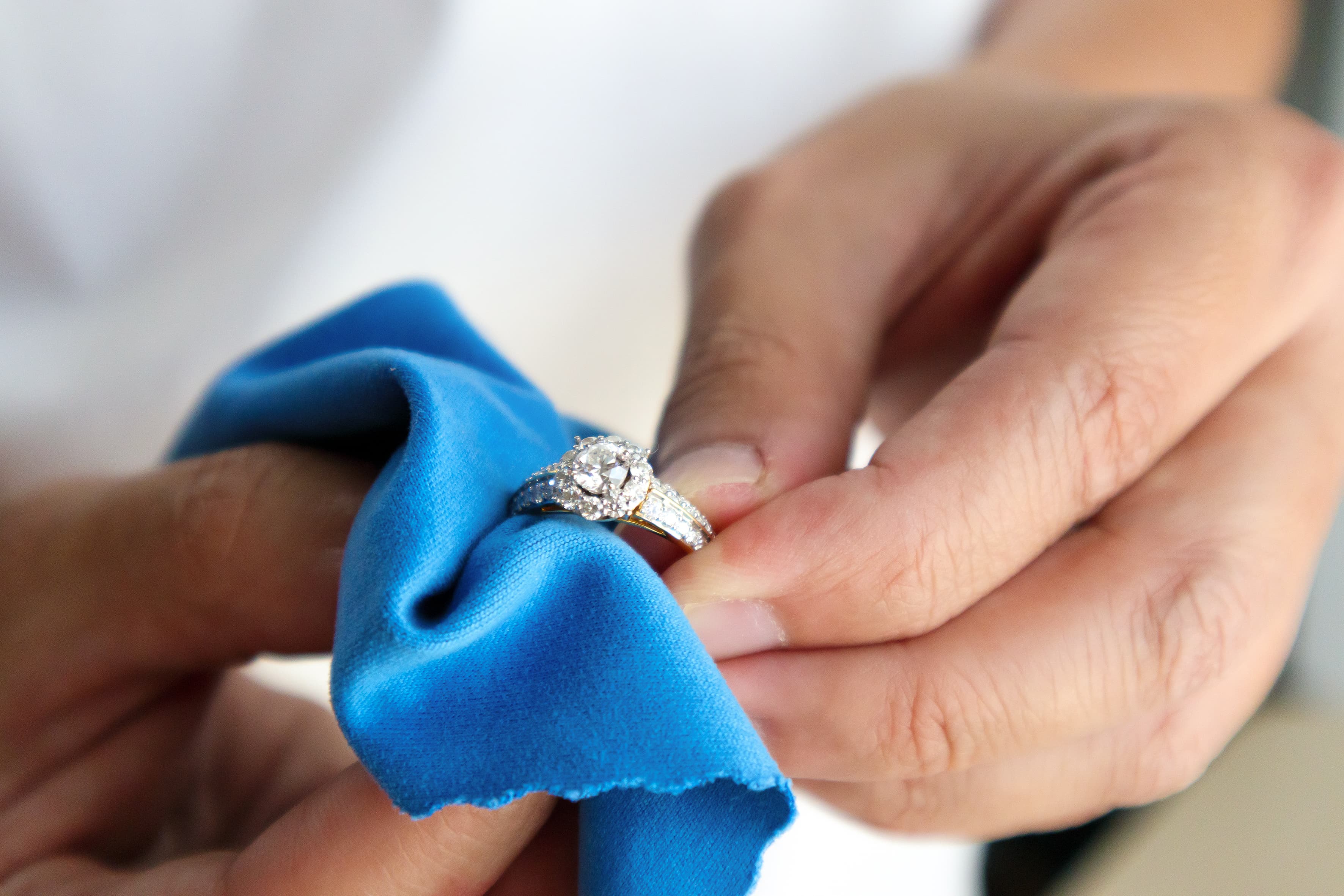
You do not need a special solution or a kit. The method every jeweller uses:
- Fill a bowl with warm (not hot) water and add a few drops of plain, non-moisturising dish soap.
- Soak the piece for 15-20 minutes to loosen the film.
- Gently work around the stone and setting with a soft-bristled brush — a baby toothbrush is ideal — paying attention to the underside of the diamond, where grime collects.
- Rinse over a strainer (not an open drain), then pat dry with a lint-free cloth.
The one thing people get wrong is the soap. Moisturising soaps, hand washes and shampoos leave a film of their own that dulls the very sparkle you are trying to restore, so use a plain, non-moisturising detergent only. Done every week or two, this keeps a diamond livelier than any occasional deep clean ever will.
The exception — porous and organic stones. Do not soak pearls, opals, emeralds or turquoise. Water and detergent work into their structure and damage them over time. Wipe these with a barely-damp soft cloth instead, and keep them well clear of the soap bowl.
Ultrasonic cleaners: not a blanket ban, a targeted danger
Ultrasonic cleaners use high-frequency vibration to shake dirt loose. The usual advice — "ask a jeweller first" — is too vague to act on. The reality is specific: an ultrasonic is genuinely safe for some stones and actively destructive for others, and the dangerous group is common, not rare.
The critical factor is treatment. Clarity enhancement and fracture-filling are routine in the trade, so "it is a diamond" does not make it ultrasonic-safe — a clarity-enhanced diamond's glass or resin filler can cloud or dislodge in the tank. Unless you know a stone's treatment history, leave ultrasonic cleaning to a professional who can check it first. Every Savoir-Faire diamond is untreated and independently certified by IGI, GIA or GCAL, so its status is documented — but many older or inherited pieces are not.
| Stone or metal | Ultrasonic? | Why |
|---|---|---|
| Untreated diamond, sapphire, ruby | Generally safe | Hard and stable, no filler to disturb |
| Plain gold and platinum | Generally safe | Solid metal tolerates vibration |
| Emerald | Avoid | Almost always oil or resin filled; vibration strips it |
| Opal | Avoid | Holds structural water; vibration causes crazing |
| Tanzanite | Avoid | Heat and shock sensitive; can crack |
| Pearl | Avoid | Organic and porous |
| Clarity-enhanced or fracture-filled diamond | Avoid | Fill can cloud or dislodge |
Storing pieces: why a diamond ruins everything it touches
Diamond is the hardest natural material there is (Mohs 10), which means it will scratch every other gem, pearl, opal and soft metal it touches — including other diamonds. Tip a box of loose rings into a drawer and you are letting the hardest thing in the box grind against everything else, diamond against diamond included. This is the specific reason behind the standard advice to keep pieces separate — it is not generic caution.
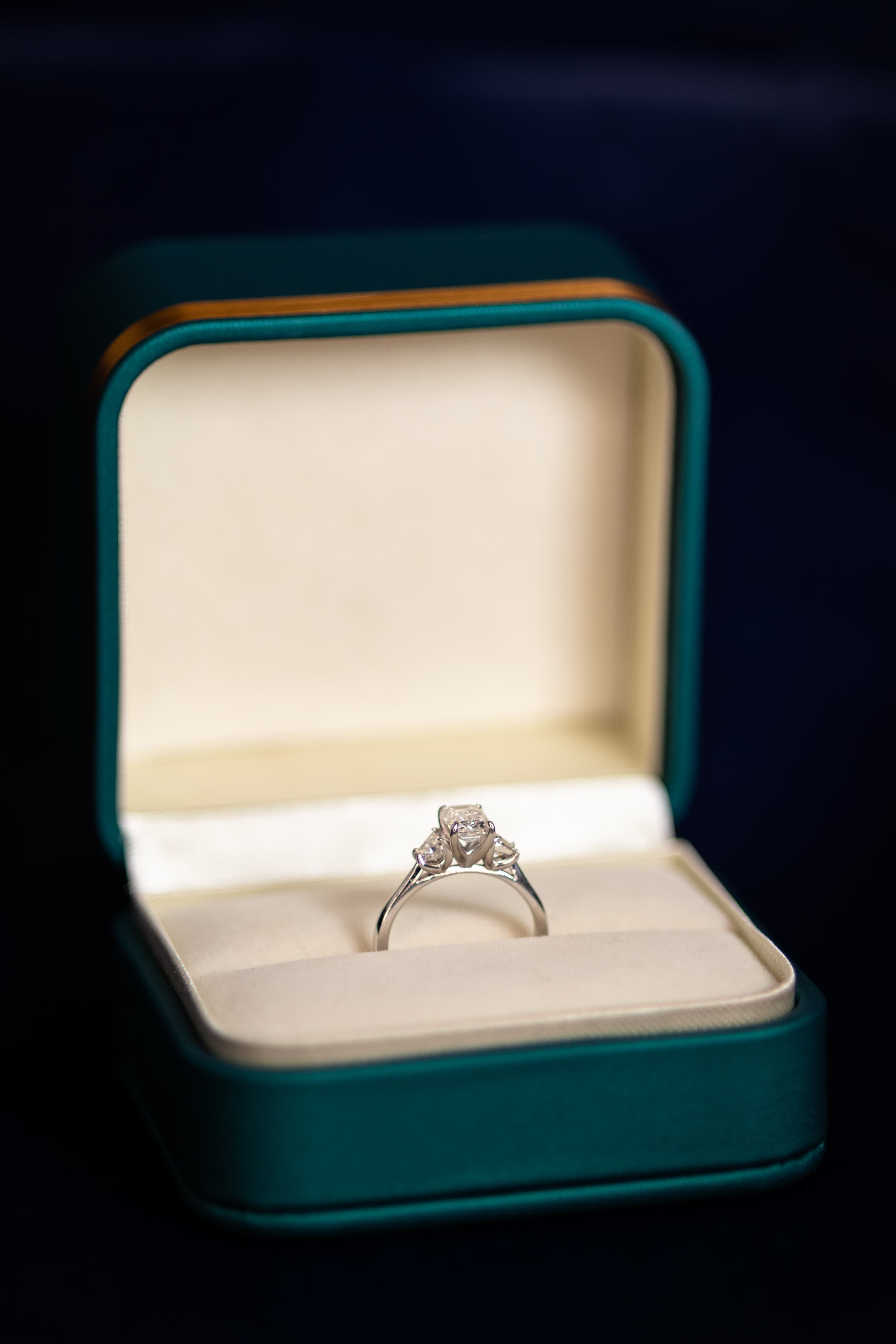
Store each piece in its own soft-lined compartment or individual pouch rather than jumbled together. Keep pearls and opals away from dry heat and direct sun as well, since both can dehydrate and craze over time. The soft-lined box your Savoir-Faire piece arrives in is made for exactly this.
Looking after the metal, not just the stone
Metals age differently, and knowing how yours behaves saves needless worry — our gold vs platinum guide covers this in full. White gold is rhodium-plated for its bright white finish, and that plating gradually wears, so a daily-worn white-gold ring typically needs re-plating every 12-18 months to stay crisp. Platinum does not lose metal when it scratches — it develops a soft patina many people prefer, and it can be repolished to a mirror finish whenever you like. Yellow and rose gold scratch more readily than platinum but polish out easily. None of this is a fault; it is simply how precious metal wears, and all of it is routine to put right.
Professional servicing: the single highest-leverage habit
Here is the fact that reframes everything else: worn or bent prongs are the leading cause of lost stones across the whole trade — well ahead of theft or accidents. A prong thins with years of wear until it can no longer grip the stone, and one day the diamond is simply gone. Caught early, the fix is trivial: re-tipping a worn prong is a routine, low-cost repair — typically $30-100 per prong in Australia. The alternative is replacing the stone outright. This is why "get it checked" is not a nice-to-have — it is the best-value action you will ever take for the ring.
A professional inspection also covers cleaning, tightening loose settings, and checking the band for thinning. On cadence, the familiar "once a year" line is a floor, not best practice. Jewelers Mutual, a leading jewellery insurer, recommends inspection and cleaning twice a year — and every three to four months for a daily-worn engagement ring, which takes the most punishment of any piece you own.
| Piece / wear | Professional check + clean |
|---|---|
| Daily-worn engagement ring | Every 3-6 months |
| Other daily-worn pieces | At least once a year |
| Occasional-wear pieces | Every 1-2 years |
| Valuation / appraisal | Every ~2 years, sooner after big metal-price moves |
Savoir-Faire rings come with a lifetime warranty and a complimentary resize within twelve months, and our Melbourne workshop handles aftercare — so bringing a ring in for a prong check is straightforward.
Insurance: insure at replacement value, never resale
The most important idea in this guide, after prong checks, is this: insure your jewellery at its replacement value — what it would cost to buy an equivalent piece new today — not its resale value. They are different numbers, and the gap is large.
This matters most for lab-grown diamonds. A lab-grown stone typically resells for only about 10-40% of its purchase price, because new lab-grown prices have fallen sharply — roughly 88-96% down from their 2018 highs, with the decline finally flattening in early 2026 as premium certified stones approach a production-cost floor. Insure a lab-grown ring on a resale basis and a claim would pay out a fraction of what replacing it actually costs. Insure it at replacement value and you are covered for the real price of buying it again. This is not a mark against lab-grown — the low upfront cost is the whole appeal — it simply means you insure on the right number. Natural diamonds hold more of their value on the second-hand market, but the same rule applies to every stone: cover it for what replacing it costs, not for what you could sell it for.
Two practical Australian notes:
- You usually do not need a formal appraisal for a lab-grown diamond. Australian insurers such as Centrestone insure lab-grown stones at retail replacement cost and generally accept your tax invoice showing the purchase price as sufficient proof — no separate valuation required. That removes a cost and a hassle many buyers wrongly assume they are stuck with.
- Refresh your valuation roughly every two years, sooner after a big metal-price move. Gold has swung hard: spot sat near US$2,658/oz in early 2025, peaked above US$4,600 in January 2026, and trades near US$3,985 in mid-July 2026 — up about 19% year-on-year. A valuation even a year or two old can badly understate today's replacement cost and quietly leave you underinsured. Our note on rising gold prices has more.
Whatever you insure, keep your IGI, GIA or GCAL certificate and your tax invoice together in a safe place — you will need them for any claim.
Warranty and insurance are two different safety nets
People often assume one covers the other. It does not. They protect against different things, and you want both.
| Warranty | Insurance | |
|---|---|---|
| Covers | Manufacturing and workmanship faults | Loss, theft, accidental damage |
| Provided by | Savoir-Faire (lifetime) | Your insurer |
| Valued on | Quality of the make | Replacement cost today |
A warranty covers the piece being made right; insurance covers the piece being lost, stolen or damaged out in the world. Note too that keeping up with routine servicing and prong checks is usually what keeps a manufacturer's or retailer's warranty valid — neglect the setting and you can void the very cover you are relying on. See our full warranty details for what is and is not included.
Common questions about jewellery care
How often should I clean my engagement ring?
A quick warm-water-and-mild-soap soak every one to two weeks keeps it sparkling, because the dulling culprit — lotion and soap film on the underside of the stone — builds up fast. A professional clean and inspection once or twice a year covers everything else.
Can I use an ultrasonic cleaner at home?
Only if you know your stone is ultrasonic-safe — untreated diamonds, sapphires and rubies, and plain gold or platinum, are fine. Never put emeralds, opals, tanzanite, pearls or any clarity-enhanced or fracture-filled diamond in one; the vibration can crack them or strip their filler. If you are unsure of the treatment history, hand-clean and leave the ultrasonic to a jeweller.
Why does my diamond look dull even though it is clean?
Almost always a film of hand cream, sunscreen or soap on the underside of the stone, which blocks returning light. It is the most common and most avoidable cause of a "lifeless" ring, and a 15-minute soak in warm soapy water usually restores full sparkle.
Should I insure my ring at what I paid or what it is worth?
Insure it at replacement value — the cost to buy an equivalent piece new today — never resale value. For lab-grown diamonds especially, resale can be as low as 10-40% of purchase price, so resale-based cover would pay out far too little to replace the ring.
Do I need a valuation to insure a lab-grown diamond in Australia?
Usually not. Australian insurers generally insure lab-grown diamonds at retail replacement cost and accept your tax invoice showing the purchase price as proof, so a separate formal appraisal often is not required. Refresh the figure roughly every two years, as metal prices move.
How often should the prongs be checked?
At least once a year for anything worn daily, and every three to six months for a daily-worn engagement ring. Worn prongs are the leading cause of lost stones, and re-tipping one early is a small, cheap repair compared with replacing a diamond.
Look after the settings and keep the sparkle clean, and a well-made ring will last a lifetime. If a prong feels loose or a stone catches on fabric, do not wait — book a consultation and our Melbourne workshop will check it over. Still deciding rather than buying? Explore our engagement ring collection, or have us source a stone to your exact spec.